
Kais AI – Agentic Intelligence Across the ERP
A conversational, multi-agent intelligence layer embedded across the entire ERP ecosystem
Product Design
AI/UX Architecture
Agent Framework Design
2024 - Present
KEBS
Overview
Kais AI is a conversational, multi-agent intelligence layer embedded across the entire ERP ecosystem — spanning Projects, Finance, Resource Management, Timesheets, Leave, HR, and Operations.
Each AI agent specializes in a functional domain while collaborating across modules to interpret context, identify risks, and recommend next-best actions.
Dashboards weren’t telling users what to do
KEBS moves thousands of data points a day across Projects, Finance, HR and Operations. And yet a delivery manager, a CFO and an HR lead were each opening four or five modules to answer a single question — why is this at risk, and what do I do next?
Revenue leakage, burnout risk and SLA breaches were discovered in weekly reviews — long after the moment to act had passed.
“Why is Phoenix behind?” required Projects, Timesheets, Resource plans and Finance — then reconciled by hand in someone’s head.
Every widget showed what was happening. Nothing explained why, or recommended a next best step.
The bet: instead of adding more dashboards, embed reasoning into every module — so the ERP stops describing and starts advising.
Three surfaces users meet Kais on
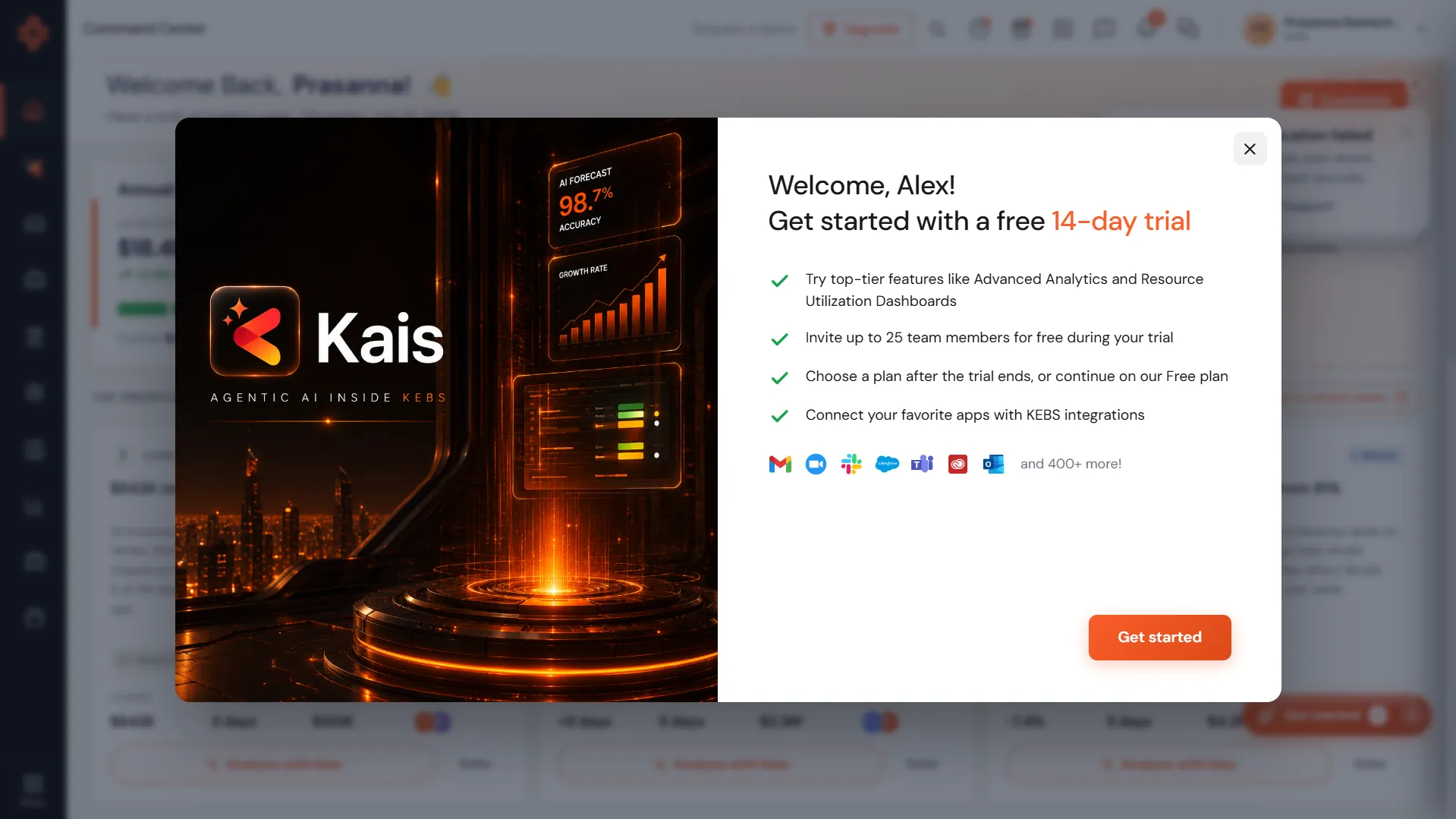
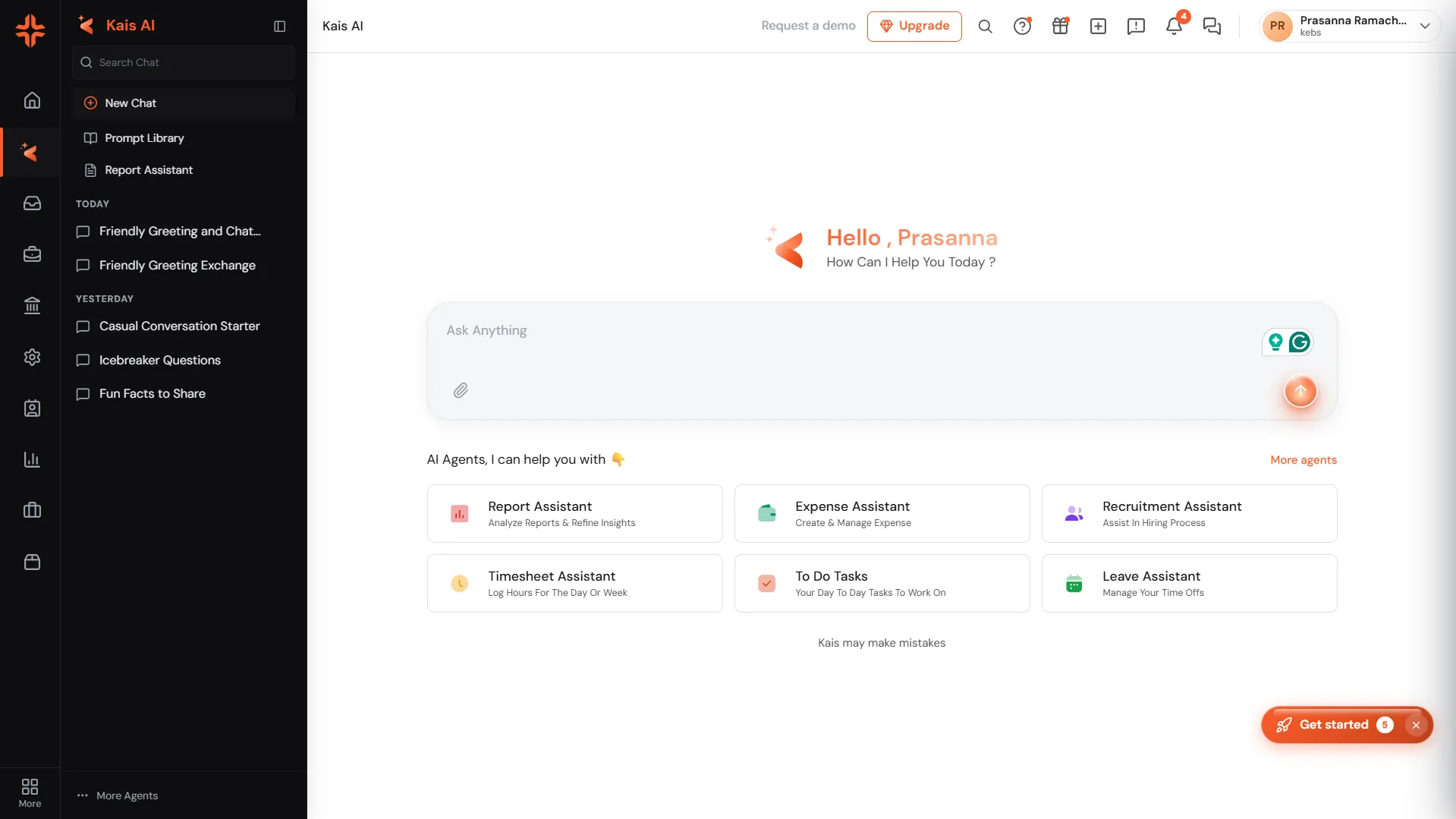
One agent layer, three deliberate entry points. Each answers a different question — where is Kais when I need it? — without forcing users to context-switch away from the work they’re already doing.
Persistent in the side-nav and a floating trigger on every page. Opens the full chat surface — prompt library, saved agents, history.
Every widget carries an inline trigger. The agent inherits the widget’s filters, so questions stay grounded in what you’re already looking at.
Kais opens the conversation. Risks, breaches and gaps arrive with a single primary action — before the user thinks to ask.
Five risks, ranked and quantified — each with a single action verb.
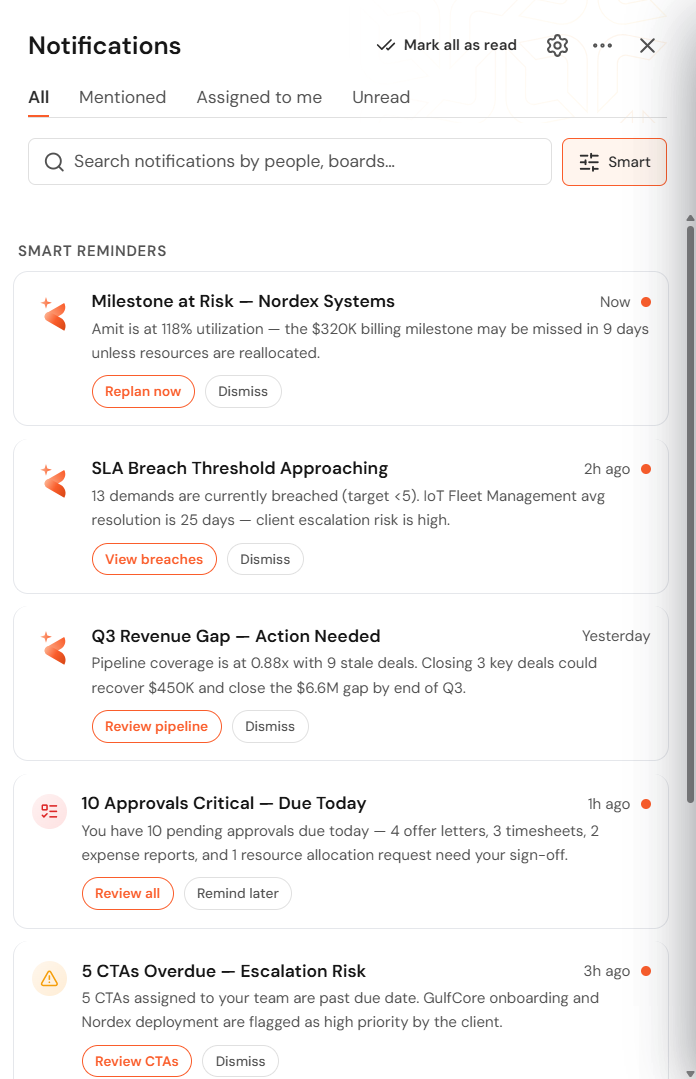
- a.Severity + time-since
A single dot and timestamp make priority readable in one glance.
- b.Quantified impact, first sentence
“$320K milestone may be missed in 9 days.” The number arrives before the reasoning.
- c.One primary verb
Replan · View breaches · Review pipeline. Kais never just tells; it hands over a next step.
- d.Dismiss lives beside act
Every reminder is reversible. Nothing Kais surfaces feels forced.
From records to reasoning
From detecting revenue leakage and project burnout risk to identifying leave impact on delivery timelines and timesheet compliance gaps — Kais AI transforms ERP from a system of records into a system that reasons.
Enterprise decisions move from reactive reporting to proactive intelligence.
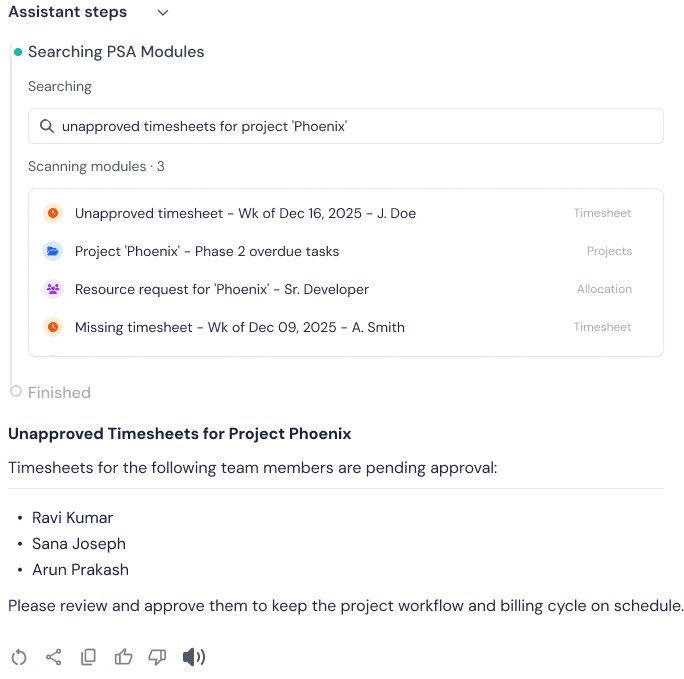
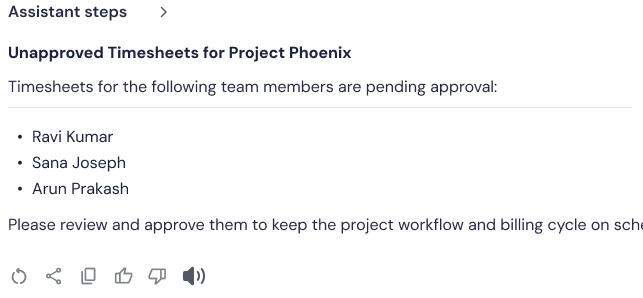
Kais defaults to the collapsed answer — expandable when a user wants to verify. Trust, without the noise of always showing the machinery.
Each cited row shows its source — Timesheet, Projects, Allocation. Users jump straight to the record instead of hunting for it.
Persistent microcopy sets expectation. Every AI output is editable, dismissable, reversible. Confidence is earned, not claimed.
One question, many agents
Enterprise questions rarely live inside a single module. Kais routes a query through the specialists that can contribute — each fetches its slice — then a synthesizer stitches the answer into a next-best action.
The query
“Why is Project Phoenix behind, and can we recover the Q3 milestone?”
Fan-out
The router reads the intent and picks the specialists who can contribute — no one agent has to know everything.
Findings
Synthesis
“Phoenix is trending six days late on the Q3 milestone. Rebalancing two tasks from Amit to Divya and clearing the three pending timesheet approvals recovers four days — enough to protect the $320K billing.”
Specialists, not one polymath. Each agent stays narrow and legible — the synthesizer is the only layer that has to be smart about the whole.
Intelligence modules
Kais AI consists of specialized agents across multiple ERP domains:
Projects
Detect revenue leakage and project burnout risk
Finance
Monitor cash flow and budget variance in real-time
Resource Management
Optimize allocation and predict capacity constraints
Timesheets & Leave
Identify compliance gaps and leave impact on delivery
What's coming
The full case study will include:
• Complete architecture overview — How the multi-agent system works
• Agent framework design — Technical implementation and agent collaboration
• UX case study — Conversational interface design and user flows
• Impact metrics — Real-world results and business outcomes
Stay tuned for the full story
I'm currently documenting the complete journey of building Kais AI — from initial concept to production deployment. Check back soon for the detailed case study.